
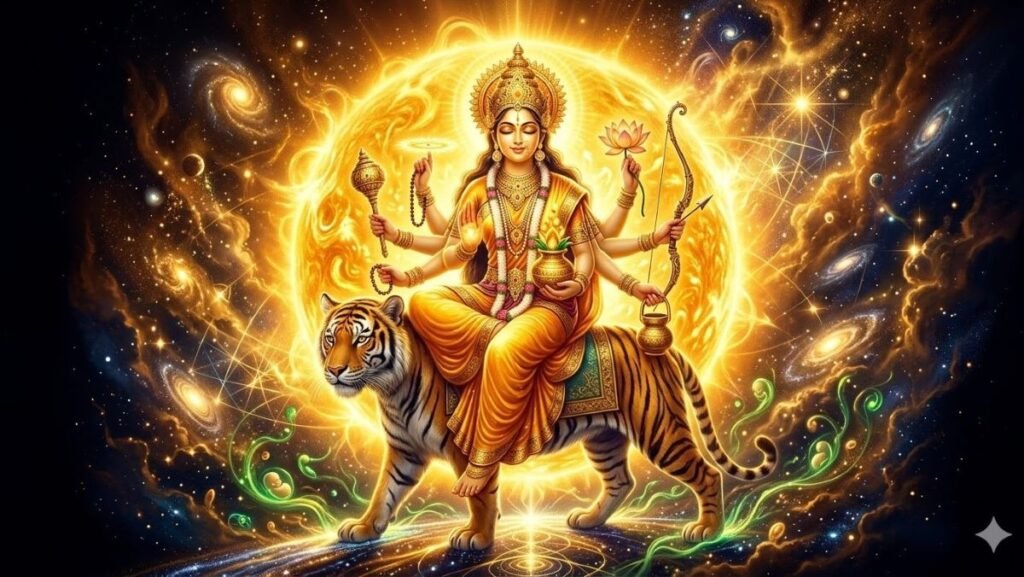
When time, space, and the universe did not exist, a mere \'smile\' initiated creation. Discover how the Vedic concept of \'Hiranyagarbha\' and Maa Kushmanda parallel modern science\'s \'Singularity\'.
Kushmanda: The Profound Scientific and Vedic Meaning
In Sanskrit, the name \'Kushmanda\' is formed by combining three highly significant words, encompassing complete astrophysics:
- Ku: Meaning \'Microscopic\' or Quantum level.
- Ushma: Meaning \'Energy\' or \'Heat\'.
- Anda: Meaning \'Cosmic Egg\' (Hiranyagarbha).
Meaning: The microscopic, intensely hot point of energy from which this vast cosmic egg (the universe) expanded. This is Maa Kushmanda.
Puranic Evidence: Creation from the Void
According to the Markandeya Purana and Devi Bhagavata, before the universe existed, there was only infinite darkness and a profound void. In that darkness, the Supreme Cosmic Energy (Adishakti) manifested and gently smiled.
The radiant light from the Goddess\'s smile pierced the darkness, creating the \'Cosmic Sphere\' (Brahmanda). Hence, she is revered as Adishakti, the ultimate creator of the universe.
The Goddess of the Solar Core:
Scriptures state that Maa Kushmanda resides within the inner core of the Sun (Suryamandal). She is the only entity in the entire universe capable of withstanding the Sun\'s blazing heat and fire. Even the Sun God derives his illuminating energy from a fraction of Maa Kushmanda\'s radiance. She has eight arms (Ashtabhuja), symbolizing the expansion of the universe in all eight directions.
Modern Science (Big Bang Theory) and the Secret of Kushmanda
Modern science, through the Big Bang Theory, posits that 13.8 billion years ago, the entire universe was compressed into an intensely hot, microscopic point called a \'Singularity\'. Then, a massive expansion occurred, creating the cosmos.
Our ancient Rishis had already named this \'Singularity\' as \"Ku-Ushma-Anda\" (Microscopic Hot Egg)!
What science calls a blind \'Bang\', Sanatan Dharma beautifully describes as the \'Smile of the Goddess\' (an expansion of consciousness). A random explosion without consciousness cannot create such a meticulously organized universe governed by gravity, planetary orbits, and life. Maa Kushmanda is that very Cosmic Consciousness.
Yoga Science: Awakening the Anahata Chakra (Heart Center)
The fourth day of Navratri is dedicated to awakening the seeker\'s \'Anahata Chakra\'.
Location: This chakra is located in the center of the chest (Heart). It is the center of love, compassion, balance, and profound peace.
- Destroying Depression and Darkness: Just as the Goddess eradicated the cosmic void with her smile, meditating on Maa Kushmanda today permanently dispels mental darkness, sadness, and depression from a seeker\'s life.
- Decision-Making Ability: Awakening the Anahata Chakra helps an individual strike the perfect balance between emotion and logic.
Navratri Day 4 Puja Vidhi: Vedic Rituals and Mahabhog
1. Auspicious Color (Green)
After the universe was created, the first thing to manifest was nature. Therefore, wearing Green is highly auspicious today. It symbolizes growth, life, and new beginnings.
2. Sacred Flowers
Maa Kushmanda loves yellow flowers, jasmine, and the flowers of the pumpkin plant (which is called Kushmand in Sanskrit).
3. Ayurvedic Mahabhog (Malpua)
Offering Malpua (an Indian sweet pancake) is considered the most auspicious Bhog today.
Ayurvedic Logic: During the mid-Chaitra weather transition, Malpua made of wheat, jaggery, and fennel provides the body with instant energy and immunity.
Proven Mantras & Stuti
Dhyana Mantra (Maa Kushmanda):
Surasampurnakalasham Rudhiraplutameva Cha.
Dadhana Hastapadmabhyam Kushmanda Shubhadastu Me.
(Meaning: May Maa Kushmanda, who holds two pitchers full of blood and nectar in her lotus hands, be propitious to me.)
Navdurga Stotra (Prayer):
Ya Devi Sarvabhuteshu Maa Kushmanda Rupena Samsthita.
Namastasyai Namastasyai Namastasyai Namo Namah.