
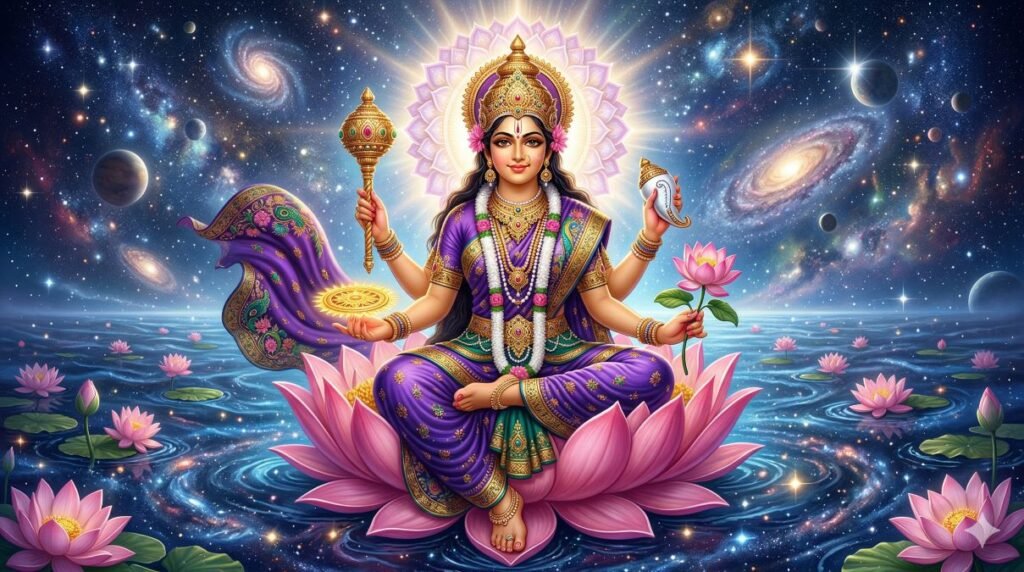
Jai Mata Di 🙏
Today is the ninth and final day of Chaitra Navratri, universally celebrated as 'Maha Navami'. This day is dedicated to the supreme, invincible, and most complete form of Adishakti, who is the absolute source of all cosmic energies and supernatural powers. In Sanatan scriptures, this supremely benevolent Goddess is revered as Maa Siddhidatri. Worshipping her on the ninth day completes the Kundalini Yoga journey, awakening the Sahasrara Chakra and bestowing the seeker with ultimate perfection.
'Siddhidatri': Meaning of the Name and the Science of Asht Siddhi
In Sanskrit, 'Siddhi' means 'perfection', 'salvation', or 'supernatural power', and 'Datri' means 'the provider'. According to the Markandeya Purana, there are eight primary supernatural powers (Asht Siddhi) in the universe. Maa Siddhidatri is the original source and sovereign of all these eight Siddhis. Whether it is a Devta, Gandharva, or a human seeker, whoever takes refuge in her is blessed with these powers. The Asht Siddhis are as follows:
- Anima: The power to reduce one's body to the size of an atom, allowing the seeker to bypass any physical barrier.
- Mahima: The power to expand one's body and consciousness to become as infinitely large as the universe itself.
- Garima: The power to make one's body as infinitely heavy as a massive mountain, rendering it immovable.
- Laghima: The power to become lighter than air or a ray of light, completely nullifying the effects of gravity.
- Prapti: The power to instantly acquire any object from any corner of the universe or to travel anywhere instantaneously.
- Prakamya: The limitless power to instantly manifest any thought or desire into physical reality.
- Ishitva: The power to establish supreme divine lordship over every living being, non-living object, and energy in the universe.
- Vashitva: The absolute power to bring any consciousness, element, or creature under one's complete control.
The Supreme Divine Form: Maa Siddhidatri has four arms. She appears in an extremely peaceful, gentle, and compassionate posture. Her lower right hand holds the 'Chakra' (discus) that controls the cosmic wheel of time, and her upper right hand holds a 'Gada' (mace). Her lower left hand holds a sacred 'Shankh' (conch), and her upper left hand holds a 'Lotus'. Her primary seat is a fully bloomed Lotus, but her mount is a fierce 'Lion', symbolizing that both absolute peace and absolute ferocity are under her command.
The Puranic Legend: Shiva's Penance and the Manifestation of 'Ardhanarishvara'
The story of Maa Siddhidatri is profoundly detailed in the Devi Bhagavata Mahapurana (Ninth Canto). It is not merely a story, but the cosmic science of the union between Prakriti (Energy) and Purusha (Consciousness).
In the beginning of creation, when the universe was to be structured and operated, Lord Shiva required those supreme powers (Siddhis) to maintain cosmic balance and initiate physical creation. Until that time, the Supreme Power (Adishakti) existed entirely in a formless state within Shiva himself. To awaken these cosmic powers into a physical, manifest form, Lord Shiva commenced a tremendously fierce and austere penance dedicated to Adishakti.
Due to Lord Shiva's selfless and intense penance, a massive turbulence occurred at the core of the universe, and the Supreme Energy manifested before him as Maa Siddhidatri. Her form was so radiant and luminous that it illuminated the entire cosmos. Manifesting before him, the Goddess granted Lord Shiva complete knowledge and authority over the eight cosmic Siddhis (Anima, Mahima, etc.).
After bestowing these powers, by the divine grace of Maa Siddhidatri, half of Lord Shiva's body transformed into the Goddess (Feminine Energy/Shakti). Half of Shiva's body became male, and the other half became female. In Sanatan Dharma, this supremely sacred and mystical form is known as 'Ardhanarishvara'. The Ardhanarishvara form is the ultimate cosmic truth, proving that without 'Shakti' (the feminine), even 'Shiva' (the masculine) is incomplete, and no creation is possible without her.
Yoga Science: Absolute Awakening of the 'Sahasrara Chakra'
On the ninth day of Navratri, the Kundalini Yoga practice reaches its ultimate peak. On this day, the seeker's consciousness is situated in the 'Sahasrara Chakra' (Crown Chakra). This chakra is located at the very top of the head (the crown) and is visualized as a thousand-petaled golden lotus.
Upon the awakening of the Sahasrara Chakra, all worldly desires, lust, and the countless karmic bondages of past lives are completely destroyed. In this chakra, the absolute union of Shiva and Shakti occurs. The seeker establishes a direct connection with Cosmic Consciousness. In this state, the seeker experiences 'Moksha' (liberation) and supreme bliss while still residing in the physical body. In Sanatan Dharma, this self-realization is considered the greatest 'Siddhi'.
Maha Navami Puja Vidhi, Maha-Kanya Pujan, and Vedokta Mahabhog: Complete Process
Maha Navami is the day of absolute completion. Worshipping Maa Siddhidatri today with proper Vedic rituals ensures the seeker receives the full merit of the nine-day Sadhana. Let us understand the step-by-step Vedic Puja Vidhi and the secret of Mahabhog on PanditVerse.
1. Puja Preparation & Sattvic Color
The seeker should wake up during Brahmamuhurta, bathe, and wear clean, soft clothes. Wearing Purple or Peacock Green clothes on Maha Navami is considered highly auspicious.
Spiritual Secret: Purple symbolizes deep spirituality, cosmic consciousness, intuition, and royal energy. This color perfectly resonates with the frequency of the Sahasrara Chakra, which is awakened today.
Spread a clean red or yellow cloth on a wooden stool (Chowki) and establish the idol or picture of Maa Siddhidatri, along with Lord Ganesha and the Kalash.
2. Maa Siddhidatri Puja Vidhi: Step-by-Step Rituals
The worship must begin with Lord Ganesha and the Kalash. Following this, the main worship of Maa Siddhidatri commences:
- Pavitrikaran & Achaman: Sit at the puja altar, take water and Kusha grass in your hand, and purify yourself and the puja items chanting the 'Pundarikaksha' mantra. Then, perform Achaman (sipping water three times).
- Sankalpa: Take water, Akshat (rice), flowers, and a coin in your right hand. Take a vow (Sankalpa) stating your name and your intent to perform this Puja and Havan for the completion of the Navratri fast and to seek the blessings of Maa Siddhidatri.
- Dhyana & Avahana: Fold your hands and meditate upon the Goddess. Chant the Dhyana mantra to invoke Maa Siddhidatri to accept your offerings.
- Shodashopachara Puja: Offer a symbolic bath to the Goddess. Offer fresh clothes, sandalwood paste, Roli, Akshat, incense (Dhoop), and light a lamp (Deep).
- Special Flower Offering: Maa Siddhidatri loves White Lotus or Red Roses. Offer a garland or at least one fresh flower to the Goddess today.
- Mantra Japa: Using a Rudraksha or Sphatik mala, chant the Goddess's mantra "Om Siddhidatryai Namah" for at least one mala (108 times). Chanting the Navarna Mantra ("Om Hreem Kleem Chamundayai Vicche") is also highly beneficial.
3. Maha Navami Kanya Pujan and Paran
Worshipping nine young girls (between the ages of 2 and 10) is mandatory on Maha Navami. Scripturally, these girls are considered the direct living embodiment of Navdurga. The detailed process is as follows:
- Invitation: Respectfully invite the young girls to your home a day prior.
- Washing Feet (Charan Pakharna): When they arrive, wash their feet in a clean plate at the entrance and touch that holy water to your forehead.
- Seating & Tilak: Seat them comfortably on a clean mat. Apply a Kumkum Tilak and Akshat on their foreheads. Tie a sacred thread (Kalawa/Mauli) on their right wrists.
- Offering Food (Bhog): Before feeding them, offer a portion of the prepared food to Maa Siddhidatri. Then, respectfully serve the girls a full meal (Poori, Kala Chana, Suji Halwa). Ensure they eat to their full satisfaction.
- Dakshina & Farewell: After the meal, offer them Dakshina (money), clothes, or gifts according to your capacity. Touch their feet to seek blessings and respectfully bid them farewell. This ritual is the highest Sanatani tradition of honoring the Feminine Divine.
4. Vedokta Mahabhog: The Secret of Halwa, Chana, and Poori
On Maha Navami, a special Vedic Mahabhog is offered to Maa Siddhidatri, consisting of Suji Halwa, Kala Chana, Poori, and Black Sesame (Kala Til).
Ayurvedic & Spiritual Secret: After nine days of strict fasting, this specific Sattvic diet restores the digestive system to its normal, robust state. Black chickpeas provide essential protein, while the Halwa provides instant energy (carbohydrates).
Importance of Black Sesame: Offering and donating Black Sesame (Kala Til) today holds immense significance. According to scriptures, offering Kala Til completely destroys sins committed in ignorance, planetary defects, and accumulated negative karma.
5. Maha Navami Havan and Aarti
After Kanya Pujan, a Havan must be performed to seal the Navratri Sadhana. Use mango wood, camphor, Guggul, and Loban. Offer oblations (Aahuti) using Durga Saptashati mantras or the Navarna mantra. Finally, perform the Aarti of Maa Siddhidatri with your family. Recite the 'Kshama Prarthana' to seek forgiveness for any mistakes made during the nine days of worship, and only then break your fast (Paran).
Proven Dhyana Mantra and Navdurga Stuti
Dhyana Mantra of Maa Siddhidatri:
Siddhagandharvayakhsadyairasurairamarairapi.
Sevyamana Sada Bhuyat Siddhida Siddhidayini.
Navdurga Stotra (Prayer Mantra):
Ya Devi Sarvabhuteshu Maa Siddhidatri Rupena Samsthita.
Namastasyai Namastasyai Namastasyai Namo Namah.