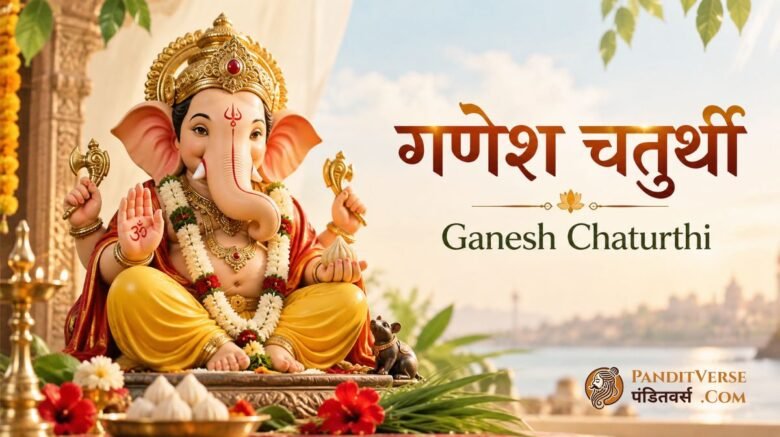
Ganesh Chaturthi 2026: Date, Puja Muhurat, Story, Rituals and the Deeper Meaning of Ganesha
Every year, when the idol of Lord Ganesha enters a home, something more than a festival begins. In the Hindu tradition, Ganesha is remembered before auspicious beginnings because he represents more than the removal of obstacles. He represents the clarity of mind needed to recognise an obstacle, the wisdom to understand it and the patience to overcome it.
This is what makes Ganesh Chaturthi more than a celebration of an elephant-headed deity. The festival brings together mythology, worship, symbolism and an important spiritual question: what happens when wisdom becomes the first step of every new beginning?
When Is Ganesh Chaturthi in 2026?
Ganesh Chaturthi will be observed on Monday, September 14, 2026. It falls on Shukla Paksha Chaturthi of the Hindu month of Bhadrapada.
- Ganesh Chaturthi: Monday, September 14, 2026
- Chaturthi Tithi begins: September 14 at 7:06 AM
- Chaturthi Tithi ends: September 15 at 7:44 AM
- Ganesh Puja Muhurat in New Delhi: 11:02 AM to 1:31 PM
- Ananta Chaturdashi: Friday, September 25, 2026
These timings are location-sensitive. The puja muhurat is given for New Delhi and can vary for other cities because Panchang calculations depend on the local sunrise and sunset. Devotees should therefore check the local Panchang for their city before planning the main puja.
Why Is Ganesh Puja Performed Around Midday?
The main Ganesh Chaturthi worship is traditionally associated with the midday period. A widely followed traditional belief connects Ganesha's appearance with this part of the day, which is why the Madhyahna period is considered especially suitable for his worship on Chaturthi.
There is an important practical point here. Madhyahna is not identical to a fixed clock time everywhere. Hindu Panchang timings are calculated according to the location, so the exact puja window changes from one city to another.
The Story of Ganesha's Birth
There are different traditional accounts associated with the birth of Ganesha. The best-known story describes how Goddess Parvati created a boy and appointed him to guard the entrance while she was bathing.
When Lord Shiva arrived, the boy refused to allow him inside because he was following Parvati's command. A confrontation followed, and Shiva severed the boy's head. Seeing Parvati's grief and anger, Shiva promised to restore the child. The boy was eventually given the head of an elephant and brought back to life. He then came to be known as Ganesha and was honoured as the lord of the ganas.
The story is traditionally narrated as the origin of Ganesha's distinctive form. Yet its symbolism goes deeper. Ganesha stands at a doorway, and a doorway separates what is outside from what is within. In a spiritual reading, this becomes a powerful image of discernment: the ability to decide what should enter our mind, attention and life.
Why Does Ganesha Have an Elephant Head?
Ganesha's elephant head is not merely an unusual feature of Hindu iconography. The elephant has long carried associations of strength, steadiness, intelligence and memory in Indian cultural imagination.
His large head is traditionally interpreted as a reminder to think broadly rather than become trapped in narrow concerns.
His large ears point towards attentive listening. Wisdom does not begin with speaking; it often begins with listening carefully.
His small eyes are commonly understood as a symbol of concentration—the ability to remain focused even when the world around us is full of distractions.
His trunk perhaps offers one of the most striking lessons. An elephant's trunk can move something heavy and can also perform remarkably delicate tasks. Ganesha's trunk therefore lends itself to the idea of adaptability: knowing when to be firm and when to be subtle.
The Meaning Behind Ganesha's One Tusk
Ganesha is also known as Ekadanta, meaning “the One-Tusked One.” Different traditions preserve different stories about how he came to have a broken tusk.
One famous tradition connects the broken tusk with the writing of the Mahabharata, in which Ganesha is said to have used his own tusk as a writing instrument. This should be understood as a traditional narrative rather than as a historical account established independently of the tradition.
Symbolically, the image of the broken tusk can be read as a reminder that meaningful knowledge and great purposes sometimes demand personal sacrifice.
Why Is Durva Grass Offered to Ganesha?
Durva grass has a special place in Ganesha worship. Although it is simple and easily available, it is regarded as a particularly dear offering to Ganesha.
Its presence in the puja carries a beautiful devotional lesson: an offering does not become meaningful because it is expensive or elaborate. A simple blade of grass, offered with devotion, can hold a place of honour in worship.
Several traditional stories explain the association between Durva and Ganesha. Rather than treating one later story as the only explanation, it is more appropriate to recognise Durva as part of the established ritual tradition of Ganesha worship.
Why Is Modak Associated With Lord Ganesha?
Modak is perhaps the most recognisable sweet associated with Ganesha. In Maharashtra, steamed ukadiche modak are particularly associated with Ganesh Chaturthi, while different regions prepare their own versions.
The significance of Modak can be understood beyond the simple description of it as Ganesha's favourite sweet. Its sweetness hidden inside a simple outer covering offers a natural spiritual metaphor: the deeper joy of knowledge and discipline is often found within a journey that may appear difficult from the outside.
How to Perform Ganesh Chaturthi Puja at Home
Ganesh Chaturthi worship does not need to become unnecessarily complicated. Families can follow their established traditions and perform the puja according to the materials and rituals available to them.
- Clean the puja area and prepare a suitable place for the idol.
- Place the Ganesha idol on a clean cloth-covered platform.
- Perform the sankalpa according to your family tradition.
- Invoke Lord Ganesha and offer water and other customary items of worship.
- Offer sandalwood, akshata, flowers, Durva and sindoor according to tradition.
- Offer Modak or another suitable naivedya.
- Chant “Om Gam Ganapataye Namah”.
- Perform Ganesha Aarti and distribute the prasad among family members.
Those following a specific sampradaya, family tradition or detailed ritual procedure may perform Prana Pratishtha and Shodashopachara Puja under appropriate guidance.
Why Is Moon Sighting Avoided on Ganesh Chaturthi?
Ganesh Chaturthi has another unusual tradition: devotees are advised to avoid looking at the Moon during a prescribed period on Chaturthi.
The tradition is connected with the story of Syamantaka Mani and Lord Krishna. According to the traditional account, Krishna was falsely accused of stealing the jewel, and the story became associated with the belief that seeing the Moon on Bhadrapada Shukla Chaturthi could lead to false allegations or unwanted accusations.
This is a religious and Puranic tradition, not a scientific claim.
For New Delhi in 2026, the period traditionally given for avoiding Moon sighting is approximately 9:06 AM to 8:04 PM on September 14. As with other Panchang timings, this period can differ by location.
When Is Ganesh Visarjan in 2026?
There is no single mandatory Visarjan day for every household. Depending on family and regional tradition, Ganesha idols may be immersed after one and a half days, three days, five days, seven days or on Ananta Chaturdashi.
Ananta Chaturdashi falls on Friday, September 25, 2026, and is the principal immersion day associated with many large public Ganesh celebrations.
The immersion itself carries a profound message. The idol is created in a physical form, worshipped with devotion and eventually returned to nature. What is temporary is the form; what the devotee is meant to retain is the spiritual meaning of the worship.
How Did the Modern Public Ganesh Festival Become Popular?
The worship of Ganesha and the observance of Ganesh Chaturthi have much older religious roots. The modern form of large public Ganesh celebrations, however, has a significant connection with Maharashtra in the late nineteenth century.
Bal Gangadhar Tilak played an important role in popularising public Ganesh celebrations during this period. The festival became a means of bringing people together in a shared public space and acquired a strong social dimension.
It is important not to confuse these two histories. Tilak did not create Ganesh worship or Ganesh Chaturthi. His contribution was to the development and popularisation of the modern public form of the celebration.
A Unique Calendar Coincidence in 2026
There is an interesting Panchang coincidence in 2026: Ganesh Chaturthi and Hartalika Teej fall on the same date, September 14.
The lunar tithi changes during the morning. According to the cited Panchang timings, Tritiya continues until around 7:06 AM, after which Chaturthi begins. The two festivals nevertheless retain their distinct religious identities, rituals and traditions. One should therefore not assume that the worship procedures of Hartalika Teej and Ganesh Chaturthi can simply be combined.
What Does Ganesha Mean in Modern Life?
Many of the obstacles people face today are not physical barriers. Distraction, impatience, ego, information overload and poor judgement can be just as disruptive.
This is where Ganesha's symbolism becomes surprisingly contemporary. His large ears remind us to listen. His small eyes remind us to focus. His large head reminds us to think beyond immediate reactions. His trunk reminds us to adapt without losing our strength.
Perhaps this is why Ganesha remains associated with beginnings—from education and business to new homes, journeys and important undertakings. A new beginning needs more than luck. It needs clarity of thought and the wisdom to choose the right direction.
When Ganesha Leaves, What Should Remain?
Ganesh Chaturthi begins with welcoming Ganesha and eventually ends with Visarjan. The idol returns to nature, but the purpose of worship is not supposed to disappear with it.
If the days spent with Ganesha leave us a little more patient, a little more attentive, a little less ruled by ego and a little more capable of making thoughtful decisions, then the festival has given us something that cannot be taken away by Visarjan.
Ganesha is worshipped as the remover of obstacles. But perhaps the deeper lesson is even more valuable: before asking for every obstacle to disappear, learn to develop the wisdom to understand which obstacles must be overcome, which must be accepted and which exist because of our own choices.
Ganapati Bappa Morya.
💬 Your opinion matters to us!
Did you find this article useful? Do you agree or disagree with our views? Please share your thoughts, questions, or suggestions in the comment box below. We read and look forward to every single comment!