Jai Mata Di 🙏
Today is the eighth day of Chaitra Navratri, universally celebrated as 'Maha Ashtami'. This day is dedicated to the most peaceful, pure, and compassionate form of Adishakti, revered in the scriptures as Maa Mahagauri. After destroying terrifying darkness and death as Kalratri on the seventh day, the Goddess reveals herself in an extremely radiant, serene, and white form on the eighth day.
In this special PanditVerse article, we will explore how Mata Parvati's dark complexion transformed into the radiant 'Mahagauri', the science behind the 'Soma Chakra', and the true Sanatani significance of Kanya Pujan on Maha Ashtami.
'Mahagauri': Origin of the Name and Divine Form
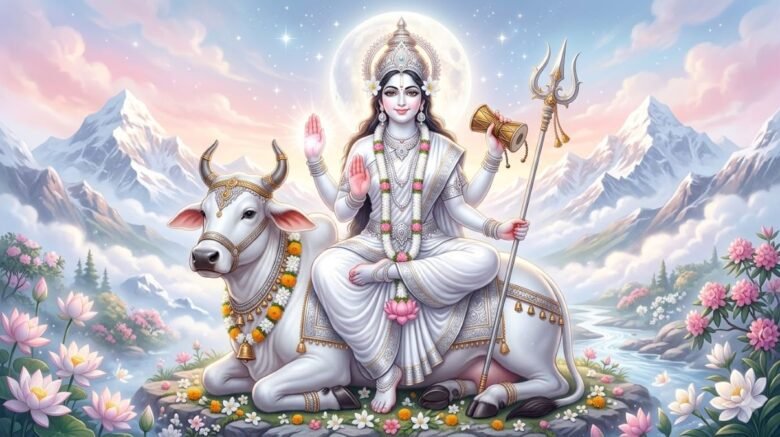
In Sanskrit, 'Maha' means 'Extreme' and 'Gauri' means 'White' or 'Radiant'. This form of the Goddess is as brilliantly white and luminous as a conch shell, the moon, and the jasmine flower. Because of this supreme radiance, she is called 'Mahagauri'.
The Serene and Pure Divine Form:
- Four-Armed Form: Maa Mahagauri has four arms. Her upper right hand is in the 'Abhaya Mudra', granting fearlessness to her devotees, and her lower right hand holds a 'Trident' (Trishul). Her upper left hand holds Lord Shiva's 'Damaru', and her lower left hand is in the 'Vara Mudra' (granting blessings).
- Attire and Adornments: She wears pure white clothes and all her ornaments are also white, earning her the name 'Shvetambaradhara'.
- Mount: The mount of the Goddess is an extremely calm 'Bull' (Vrishabha), which is the direct symbol of 'Dharma'. Therefore, she is also called 'Vrisharudha'.
The Puranic Legend: Severe Penance and the Holy Ganges Water
The original story of Maa Mahagauri's manifestation is beautifully narrated in the Shiva Mahapurana (Uma Samhita). This legend stands as proof that the fruit of true penance is always supremely radiant.
To attain Lord Shiva as her husband, Mata Parvati performed severe penance for thousands of years, completely giving up food and water. Due to this extreme austerity, her body became very weak, and after enduring the scorching sun and dust for years, her complexion turned entirely dark (Shyam).
When Lord Shiva was pleased with her selfless penance and accepted her as his wife, he released the holy waters of the River Ganga from his matted locks and bathed Mata Parvati's body. At the mere touch of the Ganges water, all the darkness was washed away. Her complexion became as radiant and brilliant as lightning. Following her penance, this supremely pure and Sattvic form came to be worshipped by the entire universe as 'Mahagauri'.
Yoga Science: 'Soma Chakra' and Mental Purification
On the eighth day of Navratri, a yoga seeker's consciousness is situated in the 'Soma Chakra' (often considered a sub-chakra located between the Ajna and Sahasrara chakras).
Science and Significance: This chakra is the center of absolute peace, purity, and Lunar Energy.
- Eradication of Sins and Trauma: Just as Lord Shiva purified the Goddess's body with Ganges water, meditating on Maa Mahagauri today washes away all accumulated sins, guilt, and mental trauma from a person's life.
- Mental Detoxification: In today's fast-paced life filled with depression and anxiety, Maa Mahagauri's Sadhana provides ultimate mental peace and serves as a profound 'Mental Detox'. The seeker's mind becomes as cool and calm as the moon.
Maha Ashtami Puja Vidhi, Kanya Pujan, and Mahabhog
1. Sattvic Auspicious Color (The Color of Purity)
Today, one should wear Pink or White clothes. These colors are symbols of love, compassion, supreme peace, and Sattvic nature. Dark or black colors should be strictly avoided today.
2. The Significance of Kanya Pujan on Maha Ashtami
According to the scriptures, Kanya Pujan holds the highest significance on the day of Ashtami. Young girls between the ages of 2 and 10 are considered the direct embodiment of Maa Mahagauri. Respectfully inviting them home, washing their feet, offering them food (Poori, Chana, Halwa), and giving Dakshina symbolizes that in Sanatan Dharma, the respect for the 'Feminine Divine' (Stri Tatva) is paramount.
3. Vedic Mahabhog (Coconut)
On Maha Ashtami, Coconut (Nariyal) is specially offered to the Goddess as Bhog.
Ayurvedic and Spiritual Secret: A coconut is called 'Shriphal'. It is hard on the outside (symbolizing discipline) and extremely cool and pure inside (symbolizing water). During the month of Chaitra (the onset of summer), coconut water protects the body from dehydration. Offering it to the Goddess and distributing it as Prasad brings wealth, prosperity, and mental coolness to the household.
Proven Dhyana Mantra and Navdurga Stuti
Dhyana Mantra of Maa Mahagauri:
While worshipping the Goddess, chant this mantra with a peaceful mind:
Shvete Vrishe Samarudha Shvetambaradhara Shuchih.
Mahagauri Shubham Dadyanmahadevapramodada.
(Meaning: May Maa Mahagauri, who rides a white bull, who wears pure white garments, who is supremely pure, and who provides ultimate joy to Lord Mahadeva, grant me auspiciousness.)
Navdurga Stotra (Prayer Mantra):
Ya Devi Sarvabhuteshu Maa Mahagauri Rupena Samsthita.
Namastasyai Namastasyai Namastasyai Namo Namah.
Conclusion: Renounce Impurities!
This supremely pure form of Maa Mahagauri teaches us that no matter how much 'darkness' (struggle or difficulty) enters our lives, the penance of truth never goes in vain. One day, divine grace will wash away all your troubles, and your life will become radiant once again. Keep your mind pure, respect women, and stand firm on the path of Dharma.
Jai Maa Mahagauri! Jai Shiva-Shakti! 🚩
💬 Your opinion matters to us!
Did you find this article useful? Do you agree or disagree with our views? Please share your thoughts, questions, or suggestions in the comment box below. We read and look forward to every single comment!