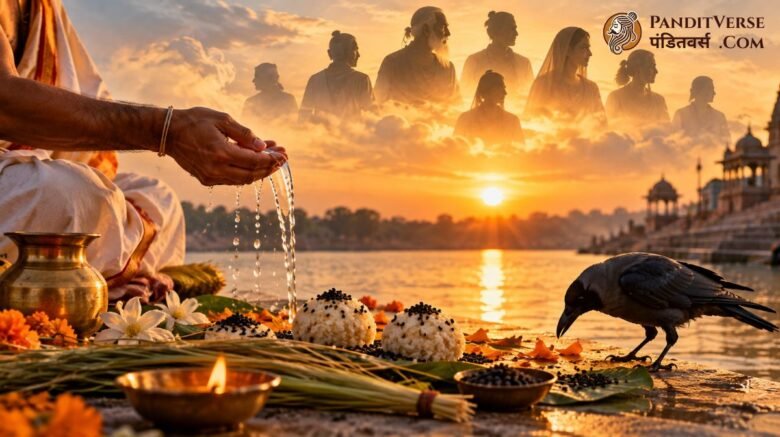
There is a period in the Hindu calendar when celebration gives way to remembrance. This is Pitru Paksha—the sacred fortnight traditionally devoted to honouring ancestors through Shraddha, Tarpana, Pinda offerings, food and charity.
In Sanatana tradition, Shraddha is not merely a ritual performed after someone's death. It is an expression of reverence towards the ancestors from whom one's life, family lineage and inherited traditions have come. Traditional Hindu texts and ritual traditions describe different forms of Shraddha and assign particular importance to different lunar Tithis.
That is why understanding Pitru Paksha means more than knowing the date of Amavasya. One must also understand which ancestor is remembered on which Tithi, why Panchami is known as Kunwara Panchami, why Navami is associated with mothers, why Chaturdashi has a special place for certain deaths, and why Sarva Pitru Amavasya is considered the most inclusive day of the fortnight.
When Is Pitru Paksha in 2026?
Pitru Paksha 2026 runs from September 27 to October 10. The preceding day, September 26, is Bhadrapada Purnima Shraddha. The main sequence begins with Pratipada Shraddha on September 27 and concludes with Sarva Pitru Amavasya on October 10.
The lunar month may be named differently in different regional Panchang traditions. In the North Indian Purnimanta system, the fortnight is associated with Ashwin Krishna Paksha, while Amanta traditions may associate it with Bhadrapada. This difference is primarily a matter of lunar-month naming and calculation.
How Is the Shraddha Tithi Decided?
The primary rule is the Hindu lunar Tithi on which the ancestor passed away. If a person passed away on Krishna Paksha Dwitiya, the Shraddha is traditionally performed on Dwitiya during Pitru Paksha. The same principle applies to Tritiya, Chaturthi, Panchami and the other Tithis.
This is why the Gregorian date of death should not automatically be treated as the Shraddha date. The Hindu lunar Tithi is the basis of the ritual.
When the death Tithi is unknown, or when the Shraddha could not be performed on the specific Tithi, Sarva Pitru Amavasya has a special place in tradition as an occasion for remembering the ancestors collectively.
Pitru Paksha 2026: Complete Shraddha Calendar
| Date | Day | Shraddha | Special Significance |
|---|---|---|---|
| September 26, 2026 | Saturday | Purnima Shraddha | For ancestors associated with Purnima Tithi |
| September 27, 2026 | Sunday | Pratipada Shraddha | Beginning of the main Pitru Paksha sequence |
| September 28, 2026 | Monday | Dwitiya Shraddha | For ancestors associated with Dwitiya Tithi |
| September 29, 2026 | Tuesday | Tritiya Shraddha | Maha Bharani |
| September 30, 2026 | Wednesday | Chaturthi and Panchami Shraddha | Kunwara Panchami |
| October 1, 2026 | Thursday | Shashthi Shraddha | For ancestors associated with Shashthi Tithi |
| October 2, 2026 | Friday | Saptami Shraddha | For ancestors associated with Saptami Tithi |
| October 3, 2026 | Saturday | Ashtami Shraddha | For ancestors associated with Ashtami Tithi |
| October 4, 2026 | Sunday | Navami Shraddha | Matri Navami |
| October 5, 2026 | Monday | Dashami Shraddha | For ancestors associated with Dashami Tithi |
| October 6, 2026 | Tuesday | Ekadashi Shraddha | For ancestors associated with Ekadashi Tithi |
| October 7, 2026 | Wednesday | Dwadashi Shraddha | Yati/Sannyasi Shraddha |
| October 8, 2026 | Thursday | Trayodashi Shraddha | For ancestors associated with Trayodashi Tithi |
| October 9, 2026 | Friday | Chaturdashi Shraddha | Ghata Chaturdashi |
| October 10, 2026 | Saturday | Sarva Pitru Amavasya | Collective remembrance of ancestors |
In the 2026 Panchang calculation, both Chaturthi and Panchami Shraddha fall on September 30. Shashthi Shraddha falls on October 1.
September 26: Purnima Shraddha
September 26 is Purnima Shraddha, while the main sequence of Pitru Paksha begins with Pratipada on September 27. Thus, calendars that mention September 26 in connection with the beginning of the broader Shraddha observance and those that mark September 27 as Pitru Paksha proper are referring to two connected but distinct stages of the lunar sequence.
Pratipada Shraddha — September 27
Pratipada is the first regular Shraddha Tithi of Pitru Paksha. Ancestors who passed away on Pratipada are traditionally remembered on this day.
Some traditions also give this day a special place for remembering maternal grandparents when their exact death Tithi is not known. Such customs vary according to family and regional tradition.
Dwitiya Shraddha — September 28
On September 28, Dwitiya Shraddha is performed for ancestors who passed away on Dwitiya Tithi. Traditional Shraddha rites may include Tarpana, Pinda offerings and food offerings according to the family's custom.
Sesame and other traditional offerings hold an important place in ancestral rites, and Tarpana with sesame is a familiar part of many Shraddha traditions.
Tritiya and Maha Bharani — September 29
September 29, 2026 is Tritiya Shraddha. The same day also carries the special observance of Maha Bharani. Bharani Nakshatra is traditionally associated with Yama and is regarded as significant for ancestral rites.
Thus, September 29 has significance both as the regular Tritiya Shraddha and as a special Nakshatra-based observance.
Kunwara Panchami 2026 — September 30
September 30, 2026 is Panchami Shraddha, traditionally known in many communities as Kunwara Panchami. The day is especially associated with remembering deceased family members who passed away unmarried.
The tradition carries a simple but meaningful idea: ancestral remembrance is not limited to those who entered married life. A person who died unmarried was still part of the family lineage and is also remembered with reverence.
In 2026, Panchami Shraddha falls on September 30, while Shashthi Shraddha falls on October 1.
Shashthi to Ashtami — October 1 to 3
Shashthi Shraddha falls on October 1, Saptami on October 2 and Ashtami on October 3. The corresponding ancestors are remembered according to their death Tithi.
Each Tithi therefore becomes an opportunity to remember a particular ancestor. The sequence ensures that the memory of the departed remains connected with the lunar calendar and the traditional cycle of Shraddha.
Matri Navami — October 4
October 4, 2026 is Navami Shraddha, traditionally known as Matri Navami. This day gives special importance to the remembrance of deceased mothers and other departed women of the family.
Matri Navami has a particularly beautiful place in Pitru Paksha because ancestral remembrance is not limited to the paternal line. Mothers, grandmothers and other women who came before the family are also remembered with reverence.
If an ancestor passed away on Navami Tithi, the regular Navami Shraddha is also performed on this day.
Dashami and Ekadashi Shraddha — October 5 and 6
October 5 is Dashami Shraddha and October 6 is Ekadashi Shraddha. Ancestors whose death occurred on the respective Tithi are remembered on these days.
The underlying principle remains the same throughout Pitru Paksha: the Shraddha is connected to the lunar Tithi of the ancestor's passing.
Dwadashi Shraddha and Sannyasi Ancestors — October 7
October 7, 2026 is Dwadashi Shraddha. Along with ancestors who passed away on Dwadashi, the day has a special traditional association with Yatis and Sannyasis.
Those who had renounced household life and followed the path of Sannyasa have distinct ancestral-rite traditions in several Hindu communities. The exact form may differ according to regional and family practice.
Trayodashi Shraddha — October 8
October 8 is Trayodashi Shraddha. Ancestors who passed away on Trayodashi are traditionally remembered through Shraddha on this day, with Tarpana, Pinda offerings and other customary rites performed according to family tradition.
Ghata Chaturdashi — October 9
October 9, 2026 is Chaturdashi Shraddha. Chaturdashi has a special place in Pitru Paksha for ancestors whose death occurred under certain unusual or untimely circumstances, including traditional references to accidents, weapons, violence, fire, water and similar causes. This observance is commonly known as Ghata Chaturdashi.
The day therefore provides a special occasion to remember those whose departure from life did not follow the ordinary course.
Sarva Pitru Amavasya 2026 — October 10
The final day of Pitru Paksha is Sarva Pitru Amavasya, also known as Mahalaya Amavasya or Pitru Amavasya. In 2026, it falls on Saturday, October 10.
This day has a particularly broad place in ancestral tradition. When the death Tithi of an ancestor is unknown, or when the regular Shraddha could not be performed on the appropriate day, Sarva Pitru Amavasya provides an important occasion for collective ancestral remembrance.
Amavasya itself is regarded as an important Tithi for Pitru rites. Thus, the final Amavasya gathers the remembrance of the fortnight into one comprehensive observance.
The Importance of Tarpana and Pinda
Water, sesame, Kusha grass and Pinda offerings occupy an important place in traditional Shraddha rites. Tarpana involves offering water while remembering the ancestors. Pinda is offered according to the prescribed ritual tradition. The ingredients and exact procedure vary among regions and families.
The heart of Shraddha is the act of offering with reverence. This is why the attitude of faith, remembrance and devotion remains central to the ritual.
Why Are Kusha and Sesame Used in Pitru Rites?
Kusha grass is regarded as sacred in Hindu ritual tradition and appears in many Vedic and post-Vedic ceremonies. It also has an established place in ancestral rites.
Sesame, especially black sesame, is traditionally used in Tarpana and other Pitru rituals. Its presence in Shraddha is therefore part of the established ritual tradition rather than merely a ceremonial ingredient.
Food Offerings, Brahmin Bhojana and Panchabali
Many Hindu traditions include feeding Brahmins during Shraddha and offering food to the cow, crow, dog and other beings. In several traditions these offerings are connected with Panchabali.
The crow is traditionally regarded in popular Hindu belief as being connected with the ancestors, which is why food is offered to it during Shraddha. Feeding other beings is also part of the broader tradition of offering food with reverence.
When Should Shraddha Be Performed?
Parvana Shraddha is traditionally performed during the Aparahna period. Kutup and Rohina Muhurtas are also regarded as important for Shraddha. The exact clock time changes according to the location and local Panchang.
Therefore, the final Shraddha Muhurta should always be checked according to the Panchang of the place where the ritual is being performed.
Does One Have to Perform Shraddha Every Day of Pitru Paksha?
For an ordinary household, performing a full Shraddha on every day of the fortnight is not the general requirement. The principal annual Shraddha is traditionally performed according to the ancestor's death Tithi.
Alongside this, special days such as Kunwara Panchami, Matri Navami, Dwadashi, Chaturdashi and Sarva Pitru Amavasya have their own religious significance. Families following particular Kulachara may observe additional rites according to their tradition.
Pitru Paksha and Pitru Rina
Sanatana thought places human life within a much larger lineage. We receive our body, family, values, language, customs and many of life's foundations from those who came before us. This relationship is expressed through the idea of Pitru Rina.
Pitru Rina is a reminder that life is not something created in isolation. Shraddha gives this awareness a sacred form by remembering the ancestors and expressing gratitude towards the lineage from which one's life has emerged.
The Most Important Days of Pitru Paksha 2026
- September 26: Purnima Shraddha
- September 27: Pratipada Shraddha
- September 29: Tritiya Shraddha and Maha Bharani
- September 30: Chaturthi Shraddha and Kunwara Panchami
- October 4: Matri Navami
- October 7: Dwadashi and Yati/Sannyasi Shraddha
- October 9: Ghata Chaturdashi
- October 10: Sarva Pitru Amavasya
What Should One Do During Pitru Paksha?
- Perform Shraddha according to the known death Tithi of the ancestor.
- Follow the traditional procedure of Tarpana and Pinda offering.
- Offer water, sesame and food according to one's family tradition.
- Follow the customary practice of Brahmin Bhojana and charity.
- Offer food to cows, crows, dogs and other beings where this is part of the family tradition.
- Remember the ancestors with devotion and gratitude.
- Use Sarva Pitru Amavasya for collective remembrance of known and unknown ancestors.
The Deeper Message of Pitru Paksha
Pitru Paksha does not merely ask us to remember that our ancestors once lived. It reminds us that we ourselves are one link in a much longer chain of generations.
The values we carry, the traditions we inherit and the life we receive are connected with people who came before us. Water, sesame, Pinda and food offered during Shraddha give this remembrance a sacred form.
The deepest spirit of Pitru Paksha is therefore not merely performing a ritual for the departed. It is remembering one's ancestors, expressing gratitude towards them and accepting one's responsibility towards the lineage that will come after us.
One who remembers the roots of the lineage understands the responsibility of becoming a strong root for the generations that will follow.
💬 Your opinion matters to us!
Did you find this article useful? Do you agree or disagree with our views? Please share your thoughts, questions, or suggestions in the comment box below. We read and look forward to every single comment!