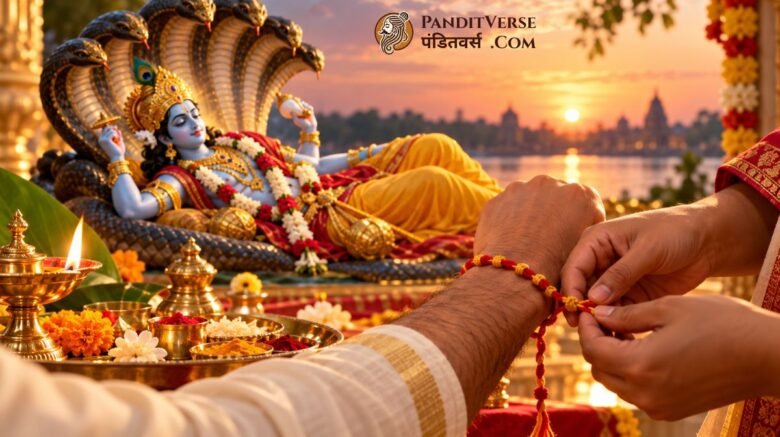
A sacred thread can look like an ordinary piece of cotton or silk. Yet on Anant Chaturdashi, that simple thread becomes part of a much deeper religious observance centred on Ananta—the infinite.
Observed on the Shukla Paksha Chaturdashi of Bhadrapada, Anant Chaturdashi is associated with the worship of Lord Vishnu in his Ananta form and the traditional tying of the Anant Sutra. The thread is traditionally made with fourteen knots.
Why fourteen? Why is the thread worn on the wrist? Is it simply considered a protective thread, or does it represent something deeper?
The answers lie in the Ananta Vrata tradition, its sacred narrative, the symbolism of the thread, and the idea of making a long-term spiritual commitment.
When Is Anant Chaturdashi in 2026?
Anant Chaturdashi will be observed on Friday, September 25, 2026. It falls on Bhadrapada Shukla Chaturdashi. According to the cited Panchang calculation, the Chaturdashi tithi begins at approximately 11:18 PM on September 24 and ends at approximately 11:06 PM on September 25. Exact puja timings vary by location, so local Panchang timings should be followed for a specific city.
The same day also marks the major conclusion of the ten-day Ganesh festival in many traditions, with Ganesh Visarjan taking place on Anant Chaturdashi. In 2026, both Anant Chaturdashi and the principal Ganesh Visarjan day fall on September 25.
What Does “Ananta” Mean?
The Sanskrit word Ananta means endless or without limit. In Vaishnava tradition, it is associated with the infinite nature of the Divine and with Lord Vishnu's Ananta form.
The name Ananta is also closely connected with Adi Shesha, the great serpent associated with Lord Vishnu. Puranic traditions describe Shesha as Vishnu's cosmic serpent and resting place, and the name Ananta is connected with his immeasurable nature.
This is why Anant Chaturdashi should not be understood merely as a day for tying a sacred thread. The thread belongs to a larger religious idea—the remembrance of the Divine as that which cannot be confined by ordinary limits.
The Anant Sutra Is More Than a Protective Thread
The central ritual of Anant Chaturdashi is the worship of Ananta followed by the wearing of a newly prepared sacred thread. The thread becomes a physical reminder of the vow undertaken by the devotee.
The symbolism is therefore closely connected with remembrance and commitment. A person does not merely wear the thread; traditionally, the thread is received after worship and becomes a visible reminder of the religious discipline associated with the Ananta Vrata.
It is useful to make this distinction because modern explanations sometimes reduce the Anant Sutra to a simple “protective thread.” That interpretation does not fully explain the ritual tradition described in the Puranic material.
What Do the 14 Knots of the Anant Sutra Mean?
The fourteen knots are one of the defining features of the Anant Sutra. The Narada Purana explicitly describes taking a new cotton or silk cord and tying fourteen knots before wearing it as part of the Ananta Chaturdashi vrata.
A widely followed traditional interpretation connects these fourteen knots with the fourteen worlds described in Hindu cosmological thought. However, this point needs to be stated carefully.
The Narada Purana passage clearly prescribes fourteen knots, but the passage itself does not explicitly explain each knot as representing one of the fourteen worlds. The connection with the fourteen worlds is therefore best presented as a traditional interpretation, rather than as the only scripturally established meaning of the knots.
This distinction matters because Hindu ritual traditions often develop layers of symbolism around an older ritual practice. The prescribed number may be ancient, while later traditions may provide additional symbolic explanations for it.
So What Should the Fourteen Knots Represent for a Devotee?
At the simplest level, they represent the traditional form of the Anant Sutra itself. At a symbolic level, the fourteen knots can remind the devotee of the larger cosmic order and of the Divine presence that extends beyond individual limitations.
The deeper point is not the number alone. It is the relationship between one thread, many knots and one spiritual commitment.
The Story of Sushila and Kaundinya
The popular Ananta Vrata tradition includes the story of Sushila and Kaundinya. The story is associated with the Ananta Vrata tradition, and the commentary to the Narada Purana's Ananta Chaturdashi passage also refers to the narrative of Kaundinya and his wife.
According to the traditional narrative, Sushila observed the Ananta Vrata and wore the sacred Anant Sutra. Her household subsequently experienced prosperity. Her husband, Kaundinya, however, did not share her faith in the sacred thread and treated it as an ordinary object.
He eventually removed and discarded the thread. After this, the family's circumstances deteriorated and Kaundinya faced a series of difficulties. He eventually understood that he had acted without respecting the religious commitment associated with the vrata.
He then sought Ananta, performed worship and expressed repentance. The story concludes with the restoration of his fortunes through the grace of Ananta.
The deeper lesson of the story is not simply that wearing a thread automatically produces wealth. The narrative places emphasis on faith, discipline, humility and commitment to a sacred vow.
That is why reducing the story to “tie the thread for prosperity” misses its central religious message.
Why Is Ananta Associated with Vishnu and Shesha?
The word Ananta occupies an interesting place in Hindu religious thought. In the Ananta Vrata tradition, Ananta is associated with Hari, or Lord Vishnu. The Narada Purana's description of the vrata identifies Ananta with a form of Hari.
At the same time, Ananta is also a name associated with Adi Shesha. Puranic accounts describe Shesha as the great serpent connected with Vishnu, and his immeasurable nature is part of the reason for the name Ananta.
These meanings do not need to be treated as competing explanations. In the religious imagination, Vishnu's infinite nature and the cosmic symbolism of Ananta Shesha are closely connected.
Why Do Men and Women Wear the Thread on Different Hands?
The Narada Purana gives a specific traditional instruction: the male devotee wears the Anant Sutra on the right hand, while the female devotee wears it on the left hand.
This practice continues in many households, although regional and family traditions can differ. Therefore, it is better understood as a traditional observance rather than as a universal rule that is practiced identically everywhere.
The more important ritual point is that the thread is worn after worship and as part of the sacred commitment of the Ananta Vrata.
How Is Anant Chaturdashi Puja Performed?
The full Puranic Ananta Vrata is considerably more elaborate than the simple household observance commonly seen today. The Narada Purana describes worship of Ananta, preparation of a new fourteen-knotted thread, offerings, charity and a later concluding ceremony known as Udyapana.
For a household observance, the essential practice can be kept simple while respecting one's family tradition.
Simple Anant Chaturdashi Puja Vidhi
- Take a bath and make the sankalpa: Begin the day with a bath and formally resolve to observe the Ananta Vrata according to your tradition.
- Prepare the puja space: Place an image or murti of Lord Vishnu or Ananta in a clean worship area. A kalasha may also be installed according to family tradition.
- Worship Ganesha: Begin the puja with remembrance and worship of Lord Ganesha.
- Worship Lord Vishnu: Offer flowers, sandalwood, incense, a lamp and suitable naivedya.
- Prepare the Anant Sutra: Prepare a new thread with fourteen knots according to the traditional practice.
- Offer the thread in worship: Place it before the deity and worship it as part of the Ananta Vrata.
- Chant Vishnu mantras: Recite a Vishnu mantra or the Ananta Vrata mantra followed in your family tradition.
- Wear the thread: Traditionally, men wear it on the right hand and women on the left, as described in the Narada Purana.
- Offer naivedya and charity: Make an offering according to your means and, if possible, give charity as part of the observance.
Where a family has an established Ananta Vrata tradition, that inherited practice should take precedence over generic online instructions.
What Is Offered During Anant Chaturdashi Vrata?
The Narada Purana describes a preparation made from wheat flour, ghee and sugar as naivedya for Ananta. It also mentions charity and other ritual offerings in the more elaborate form of the vrata.
Contemporary household practice varies considerably. Some families prepare traditional sweets, while others follow the food customs of their regional vrat tradition. There is therefore no need to treat one modern menu as universally mandatory.
Is Ananta Vrata Meant to Be Observed for Only One Day?
An interesting detail in the Puranic tradition is that the Ananta Vrata is not necessarily presented as a one-day commitment. The Narada Purana describes observing the vrata for fourteen years, followed by an Udyapana, or concluding ceremony.
Most people today encounter Anant Chaturdashi primarily as an annual festival involving worship and the tying of the sacred thread. The older vrata tradition, however, contains a much stronger idea of long-term religious commitment.
This makes the Anant Sutra more meaningful. It is not merely a thread for a single festival; in the traditional vrata framework, it can represent a commitment intended to be maintained over time.
When Should the Anant Sutra Be Removed?
There is no single practice followed identically in every region and household. The appropriate time for removing the thread therefore depends on the family tradition associated with the vrata.
The Narada Purana itself describes removing the old thread and replacing it with a new one when the Ananta Vrata is observed again.
For this reason, it is better not to present one specific removal date as a universal scriptural rule for every Hindu household.
Why Does Ganesh Visarjan Fall on Anant Chaturdashi?
For many people, Anant Chaturdashi is now closely associated with the immersion of Lord Ganesha. The ten-day Ganesh festival commonly concludes on Anant Chaturdashi, making the day one of the most visible religious dates of the month.
In 2026, the principal Ganesh Visarjan day and Anant Chaturdashi both fall on September 25.
However, the two observances should not be confused. Ganesh Visarjan belongs to the Ganeshotsava tradition, while Anant Chaturdashi is independently associated with the Ananta Vrata and worship of Ananta. Their occurrence on the same tithi connects them calendrically, but they remain distinct religious practices.
What Does the Anant Sutra Really Remind Us Of?
The Anant Sutra can be understood through three connected ideas.
- Remembrance: The thread keeps the devotee mindful of Ananta and the sacred observance beyond the moment of puja.
- Commitment: A vrata is not merely a ritual performed once; it involves a conscious religious resolve.
- Humility: The story of Kaundinya reminds the devotee that sacred symbols should not be separated from the discipline and faith they represent.
From this perspective, the spiritual meaning of the thread is not found in the material itself. Its significance comes from the devotion, remembrance and sankalpa with which it is received and worn.
The Deeper Meaning of Anant Chaturdashi
Human life is limited. Our time is limited, our physical existence is limited, and even our plans are temporary. Yet Hindu thought repeatedly turns the mind toward that which is beyond limitation.
That is the beauty of the Anant Sutra. A limited thread, tied around a human wrist, becomes a reminder of the Infinite.
The knots are visible on the thread, but the real commitment is invisible. It exists in the mind of the person who chooses to remember the Divine, follow the vrata and remain faithful to the spiritual discipline associated with it.
The Anant Sutra is tied around the wrist, but its meaning is carried in the heart. The knots belong to the thread; the sankalpa belongs to the person who wears it.

💬 Your opinion matters to us!
Did you find this article useful? Do you agree or disagree with our views? Please share your thoughts, questions, or suggestions in the comment box below. We read and look forward to every single comment!