
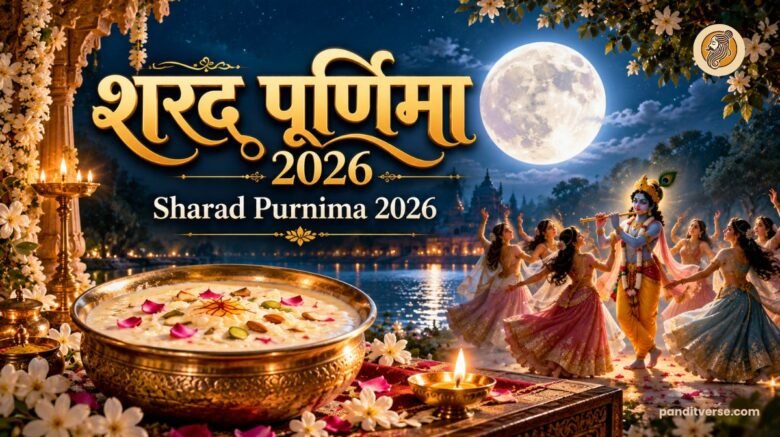
There is something distinctive about the full moon night of Sharad Purnima. The monsoon has passed, the autumn sky begins to clear, and the moonlight becomes the centre of an evening filled with prayer, devotion and traditional observances. Across Hindu households, people prepare kheer, offer prayers to Chandra Dev, worship Goddess Lakshmi and, in the Braj tradition, remember the divine Raas Leela of Shri Krishna.
Yet Sharad Purnima is more than a night associated with moonlight and sweet rice pudding. Its traditions bring together the symbolism of fullness, the devotional poetry of Krishna's Raas, the aspiration for prosperity represented by Lakshmi, and the seasonal rhythms of the Hindu calendar.
In 2026, Sharad Purnima falls on Sunday, October 25. The Purnima Tithi continues into the morning of October 26, but the principal moon-related observances take place on the evening and night of October 25.
Sharad Purnima 2026: Date and Important Timings
- Sharad Purnima: Sunday, October 25, 2026
- Purnima Tithi begins: October 25, at 11:55 AM IST
- Purnima Tithi ends: October 26, at 9:41 AM IST
- Approximate moonrise in the Meerut region: 4:58 PM IST on October 25
- Approximate Nishita period for Kojagari Lakshmi Puja: 11:40 PM on October 25 to 12:31 AM on October 26
These timings are based on published Panchang calculations for the Meerut and Delhi region. Moonrise varies by location, and the exact Nishita period should be checked against the local Panchang. The timing of a particular vrata may also depend on its specific observance rules.
What Is Sharad Purnima?
Sharad Purnima is the full moon of the Shukla Paksha in the Hindu lunar month of Ashwin. The Shukla Paksha is the fortnight during which the moon appears to grow from the new moon towards fullness. Sharad Purnima marks the culmination of that lunar phase and arrives during Sharad Ritu, the autumn season.
The festival is observed under several regional names, including Raas Purnima, Kojagari Purnima, Kojagiri Purnima and Kaumudi Purnima. The names reflect different regional customs and religious associations. In parts of North India, the night is connected with Krishna's Raas Leela. In several eastern and western Indian traditions, it is especially associated with Lakshmi worship, night vigils and the preparation of milk-based offerings.
These customs are not identical everywhere. A family observing Kojagari Lakshmi Puja may follow a different ritual sequence from a family whose principal observance centres on Krishna bhakti. Both belong to the wider cultural landscape of Sharad Purnima.
Sharad Ritu and the Meaning of Ashwin Shukla Purnima
Sharad Purnima takes place after the monsoon, when the sky often becomes clearer and the nights offer striking views of the moon. In traditional Indian life, seasonal changes shaped agriculture, food practices, community celebrations and religious observances. The autumn full moon therefore became a natural occasion for moon viewing, devotional gatherings and night-time worship.
Why the Shukla Paksha Matters
The lunar month is divided into two pakshas. Shukla Paksha begins after Amavasya and continues as the visible moon grows. Krishna Paksha follows the full moon as the visible moon wanes. Sharad Purnima marks the full-moon culmination of the Ashwin Shukla Paksha.
From a spiritual perspective, the waxing moon can be understood as a symbol of gradual development. Just as its visible form grows over successive nights, qualities such as patience, devotion, self-discipline and understanding develop through continued effort. This is a reflective interpretation of the festival rather than a separate astronomical rule.
The Belief in the Moon's Sixteen Kalas
A widely held Hindu belief associates Sharad Purnima with the moon being complete in all sixteen kalas. In traditional religious language, kalas can refer to aspects, powers or expressions of completeness. The belief is also connected in devotional traditions with Shri Krishna, who is often described as Purna Purushottama and associated with the fullness of divine qualities.
Sharad Purnima's luminous moon has consequently become a symbol of completeness, balance and spiritual fulfilment. The popular belief that its rays carry amrita, or nectar, explains why devotees traditionally place kheer in the moonlight and later distribute it as prasad.
Why Sharad Purnima Is Associated with Shri Krishna's Raas Leela
In the devotional traditions of Braj, Sharad Purnima is closely associated with Shri Krishna's Maharaas. According to the celebrated narrative, Krishna's flute calls the gopis to Vrindavan, where the divine Raas unfolds on an autumn full-moon night. This association gives the festival its regional name, Raas Purnima.
The principal scriptural foundation for the Raas narrative is the Raas Panchadhyayi in the Tenth Skandha of the Shrimad Bhagavata Mahapurana. These chapters describe Krishna's relationship with the gopis through a devotional narrative that explores love, longing, surrender and divine presence.
The Spiritual Meaning of Maharaas
Within Vaishnava devotional interpretation, the Raas Leela is not simply a story of earthly romance. It expresses the soul's longing for the Divine and the intensity of a relationship grounded in devotion. The flute can be understood as a call that draws the devotee away from distractions and towards spiritual awareness.
The gopis' devotion is often interpreted as an image of wholehearted surrender. In this understanding, bhakti is not merely the performance of rituals; it also involves humility, sincerity and a willingness to place the Divine at the centre of one's life.
Different Vaishnava traditions explain the theological meaning of the Raas Leela in their own ways. It is therefore more accurate to recognise it as a rich devotional tradition than to reduce it to one universal interpretation.
Kojagari Purnima: Why Is Goddess Lakshmi Worshipped at Night?
In several regions, Sharad Purnima is known as Kojagari or Kojagiri Purnima. The name is commonly linked with the Sanskrit question, “Ko jagarti?” meaning “Who is awake?” According to regional folklore, Goddess Lakshmi moves through the world on this night and blesses those who remain awake and worship her.
This belief gives rise to the tradition of a night vigil and Lakshmi Puja. Some families perform the principal worship during Nishita Kaal, the middle portion of the night, while others worship after sunset or combine Lakshmi worship with the evening moon offering. The precise practice depends on regional custom and the family's religious tradition.
The Deeper Meaning of Lakshmi Worship
Goddess Lakshmi represents prosperity, auspiciousness, abundance and well-being. Her worship need not be understood only as a request for wealth. Prosperity can also include food, meaningful work, harmony within the household, generosity and the wisdom to use resources responsibly.
The Kojagari tradition of staying awake can also serve as a reminder of alertness and responsibility. Remaining attentive to one's duties, opportunities and conduct is one way of honouring the broader values associated with prosperity.
Why Is Kheer Placed in the Moonlight?
One of the best-known Sharad Purnima customs is preparing kheer from milk and rice, offering it to the deity and placing it in a clean area where the moonlight can reach it. The kheer is later shared as prasad, according to the family's tradition.
Traditional belief holds that the moonlight of Sharad Purnima is nectar-like and that kheer exposed to it becomes a special offering. This belief has helped preserve the custom across generations. It is a religious tradition, not proof that moonlight transforms food into a medicine or gives it scientifically established healing properties.
The Symbolism of Kheer and Prasad
Milk and rice are familiar ingredients in Indian festive cooking and worship. They can be understood as symbols of nourishment and sustenance. When food is first offered to the Divine and then shared as prasad, the act expresses gratitude for what one has received and the willingness to share it with others.
There is no universally established scientific time window during which kheer must be exposed to moonlight. Devotees can follow the local moonrise and their family tradition. If kheer is kept outside overnight, it must be protected from insects, dust and animals. Because it contains dairy, it should not be left for long periods at unsafe temperatures. Refrigerate it when appropriate and prioritise food safety while observing the ritual.
Sharad Purnima Puja Vidhi: A Practical Guide
The puja can be performed at home with simple materials and sincere devotion. The exact procedure differs across regions and traditions. The following sequence is a practical guide for households wishing to worship Goddess Lakshmi and Chandra Dev.
- Morning preparation: Bathe, wear clean clothes and tidy the place of worship. Those observing a fast may make a personal sankalpa according to their family tradition and physical capacity.
- Arrange the altar: Place an image of Goddess Lakshmi, Lord Vishnu or your chosen deity in the prayer area. Keep a clean vessel of water ready for the moon offering.
- Light a diya: Light a ghee or oil lamp and offer incense, flowers, akshata and available fruits or sweets.
- Worship Goddess Lakshmi: Recite a Lakshmi mantra, the Shri Sukta or a familiar Lakshmi stuti according to your tradition. A sincere prayer is also appropriate.
- Offer arghya to the moon: At the local moonrise, view Chandra Dev and offer clean water. Pray for clarity, peace, well-being and auspiciousness.
- Prepare and offer kheer: Cook milk-and-rice kheer, offer it to the deity and place it where moonlight can reach it if this is part of your custom. Store and distribute the prasad safely.
- Observe the night vigil: Families that follow the Kojagari tradition may remain awake for devotional singing, mantra japa, Lakshmi stuti or religious reading. The practice should be adapted to health and personal circumstances.
- Give in charity: Offer food, clothing or other useful assistance to someone in need according to your means. Charity is most meaningful when offered with compassion rather than display.
Mantras for Sharad Purnima
Devotees may recite simple, commonly used mantras during worship. Those following a specific initiated practice should observe the guidance of their teacher or religious tradition.
Chandra Dev Mantra
Om Som Somaya Namah.
This is a simple name-mantra used in worship of Chandra Dev.
Goddess Lakshmi Mantra
Om Shreem Mahalakshmyai Namah.
This is a widely used mantra in the worship of Goddess Lakshmi. Along with prosperity, devotees may pray for wisdom, contentment and the ability to use their resources well.
Sharad Purnima Vrat: Who Observes It and How?
Some devotees observe a fast throughout the day and break it according to their family's ritual practice, while others follow a fruit-based diet or simply perform the puja and offer arghya to the moon. There is no single fasting method that applies uniformly to every region and household.
Fasting should be adapted to age, health and personal circumstances. People who are pregnant, unwell, taking regular medication or managing other medical needs should avoid a restrictive fast unless it is appropriate for them and consistent with medical advice. Devotion does not require unnecessary harm to the body.
Is Sharad Purnima on October 25 or October 26 in 2026?
The confusion arises because the Purnima Tithi extends across two calendar dates. According to the cited Panchang calculations, it begins at 11:55 AM on October 25 and ends at 9:41 AM on October 26. The principal Sharad Purnima night observances take place on October 25 because the full-moon tithi is present during that evening and night.
Morning bathing, charity and other appropriate religious observances can be performed on October 26 before the tithi ends. The rules for a particular vrata or puja may differ, so devotees should consult their local Panchang and family tradition where the distinction matters.
What Sharad Purnima Teaches Us Today
Sharad Purnima brings together several meaningful ideas. The full moon offers an image of completeness reached through gradual growth. Krishna's Maharaas expresses the depth of devotion and surrender. Lakshmi worship reminds devotees that prosperity should be accompanied by awareness, good conduct and gratitude. Sharing kheer as prasad turns these values into a simple act of community and care.
The festival therefore offers more than a beautiful night under the moon. It invites us to deepen our relationships, remain attentive to our responsibilities and share what we have with others. The light of the full moon becomes a reminder that a fulfilled life is not measured only by what we acquire, but also by the love, contentment and generosity with which we live.


💬 Your opinion matters to us!
Did you find this article useful? Do you agree or disagree with our views? Please share your thoughts, questions, or suggestions in the comment box below. We read and look forward to every single comment!