
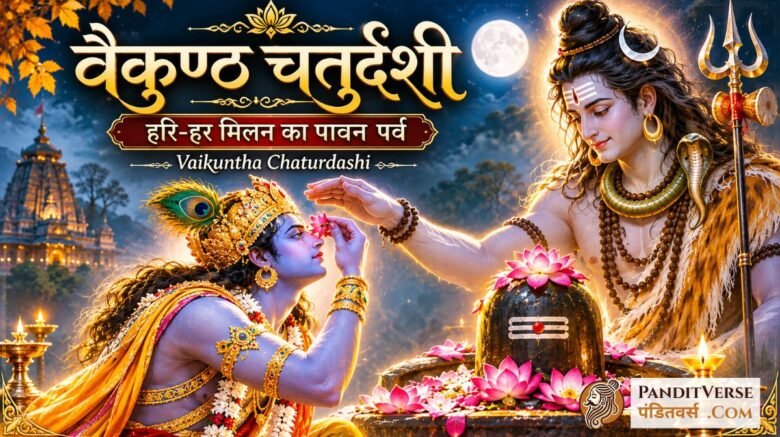
Vaikuntha Chaturdashi: When Lord Vishnu Offered His Lotus Eye to Lord Shiva
The fourteenth day of the bright fortnight of Kartika is observed as Vaikuntha Chaturdashi. It is a sacred occasion dedicated to the worship of Lord Vishnu and Lord Shiva together. The festival is closely associated with Hari-Hara Milan, the divine harmony between Hari (Vishnu) and Hara (Shiva).
Vaikuntha Chaturdashi 2026: Date and Puja Muhurat
In 2026, Vaikuntha Chaturdashi will be observed on Monday, 23 November. According to the New Delhi Panchang, the Kartika Shukla Chaturdashi Tithi begins at 2:36 AM on 23 November and ends at 11:42 PM on the same day.
- Vaikuntha Chaturdashi: Monday, 23 November 2026
- Chaturdashi Tithi Begins: 2:36 AM, 23 November
- Chaturdashi Tithi Ends: 11:42 PM, 23 November
- Nishita Kaal: 11:41 PM, 23 November to 12:35 AM, 24 November
- Shiva Puja – Arunodaya Period: Approximately 5:03 AM to 6:50 AM, 24 November
According to the traditional observance, Lord Vishnu is worshipped during Nishita Kaal, while Lord Shiva is worshipped during the Arunodaya period. In Kashi, the sacred bath at Manikarnika Ghat and the worship of Lord Vishveshwara hold special significance on this occasion.
Note: These timings are based on the New Delhi Panchang. Since Chaturdashi Tithi ends at 11:42 PM on 23 November, most of the Nishita Kaal falls during Purnima Tithi. Actual timings may vary by location, so devotees should follow their local Panchang and temple traditions.
The story of this observance is described in the Vaishnava Khanda of the Skanda Purana, in the Kartikamasa Mahatmya, Chapter 35. It tells how Lord Vishnu travelled to Kashi, worshipped Lord Vishveshwara with a thousand golden lotuses and ultimately offered his own lotus-like eye when one flower was missing. Lord Shiva was deeply pleased and bestowed the Sudarshana Chakra upon him.
Why Did Lord Vishnu Come to Kashi with a Thousand Lotuses?
According to the Skanda Purana, during the age of Krita, Lord Vishnu arrived in Kashi on Kartika Shukla Chaturdashi. In the final part of the night, he bathed at Manikarnika. He then took a thousand golden lotuses and went to worship Lord Shiva.
After worshipping Lord Vishveshwara, Vishnu began offering the lotuses to Shiva, accompanied by Goddess Parvati. He had resolved to offer one lotus with each of Shiva's thousand names. Every flower was to be part of this sacred offering.
Lord Shiva wished to witness the depth of Vishnu's devotion. He secretly removed one lotus from the collection. When Vishnu began the worship and counted the flowers, he discovered that one was missing.
He searched everywhere for the missing flower. For a moment, he wondered whether he had made a mistake in counting the lotuses or reciting Shiva's names. He soon realised that the names had been recited correctly; the shortage was in the number of flowers.
When One Lotus Was Missing, Vishnu Offered His Own Eye
Vishnu had resolved to complete the worship with one thousand lotuses. He wondered how he could fulfil his vow when one flower was missing. Going out to find another lotus would interrupt the worship he had already begun.
Then he remembered one of his own names: Pundarikaksha, the lotus-eyed one. His eyes were compared to beautiful lotuses. He decided that his own eye could take the place of the missing flower.
With complete resolve, Lord Vishnu removed his lotus-like eye with his forefinger and offered it to Mahadeva. Pleased by this extraordinary devotion, Lord Shiva appeared before him.
The Original Sanskrit Verse from the Skanda Purana
पुण्डरीकाक्ष इत्येवं मां वदन्ति मुनीश्वराः।
नेत्रं मे पद्मसदृशे पद्मार्थे त्वर्पयाम्यहम्॥
Meaning: Lord Vishnu reflects: The great sages call me Pundarikaksha, the lotus-eyed one. My eye resembles a lotus, so I shall offer it in place of the missing flower.
Reference: Skanda Purana, Vaishnava Khanda, Kartikamasa Mahatmya, Chapter 35, verses 11–12.
What Did Lord Shiva Give to Lord Vishnu?
Lord Shiva was deeply pleased with Vishnu's devotion. He declared that there was no devotee equal to Vishnu among all beings in the three worlds. Shiva also spoke of Vishnu's responsibility to protect the worlds.
Vishnu then explained that powerful Daityas threatened the worlds and asked how he could overcome such formidable enemies. In response, Lord Shiva gave him the Sudarshana Chakra and asked him to use it against the Daityas.
एतत्सुदर्शनं चक्रं महादैत्यनिकृन्तनम्।
गृहाण भगवन् विष्णो मया तुभ्यं निवेदितम्॥
Meaning: Lord Shiva says: O Lord Vishnu, accept this Sudarshana Chakra, which is capable of destroying mighty Daityas. I offer it to you; use it to overcome them.
Reference: Skanda Purana, Vaishnava Khanda, Kartikamasa Mahatmya, Chapter 35, verse 18.
Thus, Lord Shiva bestowed the Sudarshana Chakra upon Lord Vishnu. The episode celebrates their divine relationship through devotion, respect and mutual grace.
How Did the Day Become Known as Vaikuntha Chaturdashi?
Lord Shiva then explained the special significance of the day. He recalled that Vishnu had arrived in Kashi from Vaikuntha on Kartika Shukla Chaturdashi, bathed at Manikarnika during Brahma Muhurta and worshipped the Vishveshwara Lingam with a thousand lotuses.
Because of this sacred worship, Shiva declared that the day would become famous throughout the worlds as Vaikuntha Chaturdashi.
सहस्रकमलैस्तस्माद्भविष्यति मम प्रिया।
विख्याता सर्वलोकेषु वैकुण्ठाख्या चतुर्दशी॥
Meaning: Because of the worship performed with a thousand lotuses, this Chaturdashi shall become dear to me and famous throughout the worlds as Vaikuntha Chaturdashi.
Reference: Skanda Purana, Vaishnava Khanda, Kartikamasa Mahatmya, Chapter 35, verse 22.
The same chapter concludes the divine exchange with a clear instruction to worship both Hari and Hara with devotion.
तस्मात्सर्वप्रयत्नेन पूज्यौ हरिहरावुभौ॥
Meaning: Therefore, both Hari and Hara should be worshipped with sincere devotion and every effort.
Reference: Skanda Purana, Vaishnava Khanda, Kartikamasa Mahatmya, Chapter 35, verse 31.
The Same Devotion in the Shiva Mahimna Stotram
The episode of Vishnu offering his eye in place of a lotus is also beautifully remembered in the Shiva Mahimna Stotram. Its nineteenth verse praises the depth of Vishnu's devotion to Lord Shiva.
हरिस्ते साहस्रं कमलबलिमाधाय पदयो-
र्यदेकोने तस्मिन्निजमुदहरन्नेत्रकमलम्।
गतो भक्त्युद्रेकः परिणतिमसौ चक्रवपुषा
त्रयाणां रक्षायै त्रिपुरहर जागर्ति जगताम्॥
Meaning: O Lord who destroyed Tripura, Hari had resolved to offer a thousand lotuses at your feet. When one flower was missing, he offered his own lotus-like eye. The intensity of that devotion took the form of the Sudarshana Chakra, which protects the three worlds.
This verse captures the heart of the episode. Vishnu's offering is not merely a ritual act; it expresses complete surrender to the one he worships.
The Hari-Hara Worship Tradition on Vaikuntha Chaturdashi
The Skanda Purana describes the order of worship for Vaikuntha Chaturdashi. It speaks of fasting during the day, worshipping Lord Vishnu in the evening and then worshipping Lord Shiva. It also mentions the worship of Hari during the night and Shiva at the time of dawn.
Kashi holds a special place in this observance. The tradition associated with Manikarnika Ghat and the worship of Lord Vishveshwara gives the festival a distinct place in the city's religious life. Devotees remember both deities and seek their blessings together.
The Significance of Tulsi and Bilva Leaves
Tulsi holds a special place in the worship of Lord Vishnu. It is regarded as especially dear to Shri Hari, and Tulsi leaves are traditionally offered during Vaishnava worship. Bilva leaves, on the other hand, are among the most beloved offerings to Lord Shiva.
Some regional traditions observe a special exchange on Vaikuntha Chaturdashi: Tulsi leaves are offered to Shiva, while Bilva leaves are offered to Vishnu. This practice is understood as a symbol of the unity and mutual reverence of Hari and Hara. The custom is not followed in exactly the same way everywhere, so devotees may follow their family or temple tradition.
Vaikuntha Chaturdashi Puja Vidhi
Devotees observe the day according to their family and regional traditions. The Skanda Purana describes fasting during the day, worship of Vishnu in the evening and worship of Shiva thereafter. A simple home puja may be performed in the following way:
- Morning bath and sankalpa: Take a bath in the early morning, wear clean clothes and resolve to worship Lord Vishnu and Lord Shiva with devotion.
- Prepare the worship space: Place images or idols of Vishnu and a Shiva Lingam in a clean place. Arrange water, panchamrita, flowers, lotus, Tulsi leaves, Bilva leaves, sandal paste, akshata, incense, lamps and naivedya.
- Worship Lord Vishnu: In the evening, offer water, sandal paste, yellow flowers, lotus flowers, Tulsi leaves, fruits and naivedya. Recite the Vishnu Sahasranama or a Vishnu stuti.
- Worship Lord Shiva: Perform abhisheka with clean water and panchamrita. Offer Bilva leaves, flowers, sandal paste, incense and a lamp.
- Chant the Hari-Hara mantras: Recite the mantras of Lord Vishnu and Lord Shiva. Chant 108 times or according to your capacity.
- Read the sacred account: Recite the Vaikuntha Chaturdashi story and the nineteenth verse of the Shiva Mahimna Stotram.
- Aarti and charity: Perform aarti for both deities and offer food, clothes or dakshina in charity according to your means.
Important Mantras for Vaikuntha Chaturdashi
The Dwadashakshara Mantra of Lord Vishnu
ॐ नमो भगवते वासुदेवाय॥
This is the celebrated twelve-syllable mantra of Lord Vishnu. Devotees chant it while meditating on Shri Hari.
The Panchakshara Mantra of Lord Shiva
ॐ नमः शिवाय॥
This is the sacred five-syllable mantra associated with Lord Shiva and is widely used in Shiva worship.
Vishnu Dhyana Stotram
शान्ताकारं भुजगशयनं पद्मनाभं सुरेशम्।
विश्वाधारं गगनसदृशं मेघवर्णं शुभाङ्गम्॥
लक्ष्मीकान्तं कमलनयनं योगिभिर्ध्यानगम्यम्।
वन्दे विष्णुं भवभयहरं सर्वलोकैकनाथम्॥
Meaning: I bow to Lord Vishnu, whose form is peaceful, who rests upon the serpent, whose navel bears the lotus and who sustains the universe. He is the beloved of Lakshmi, the lotus-eyed Lord and the refuge of all worlds.
Shiva Dhyana Mantra
कर्पूरगौरं करुणावतारं संसारसारं भुजगेन्द्रहारम्।
सदा वसन्तं हृदयारविन्दे भवं भवानीसहितं नमामि॥
Meaning: I bow to Lord Shiva, radiant like camphor, the embodiment of compassion, the essence of existence and the one adorned with the king of serpents, together with Goddess Bhavani.
Fasting and Charity on Vaikuntha Chaturdashi
Many devotees observe a fast on Vaikuntha Chaturdashi according to their family tradition and capacity. Some keep a complete fast, while others take fruits or simple sattvic food. The purpose of fasting is to turn the mind towards worship and remembrance of the Divine.
Offering food, clothes, lamps and useful items to those in need is considered auspicious. Devotional singing, mantra recitation and reading sacred texts are also meaningful ways to observe the day.
The Spiritual Message of Vaikuntha Chaturdashi
In this sacred account, Lord Vishnu is prepared to offer his own eye to complete the worship of Lord Shiva. Shiva, pleased with this devotion, blesses Vishnu with the Sudarshana Chakra. The exchange reflects complete surrender, reverence and divine grace.
Vaikuntha Chaturdashi reminds devotees that sincere worship rises above pride and division. The joint worship of Lord Vishnu and Lord Shiva encourages humility, respect and harmony. As devotees remember Hari and Hara on this sacred day, they pray for wisdom, compassion and the strength to follow dharma.
May the grace of Lord Vishnu and Lord Shiva bring devotion, peace and righteousness into every home.



💬 Your opinion matters to us!
Did you find this article useful? Do you agree or disagree with our views? Please share your thoughts, questions, or suggestions in the comment box below. We read and look forward to every single comment!