
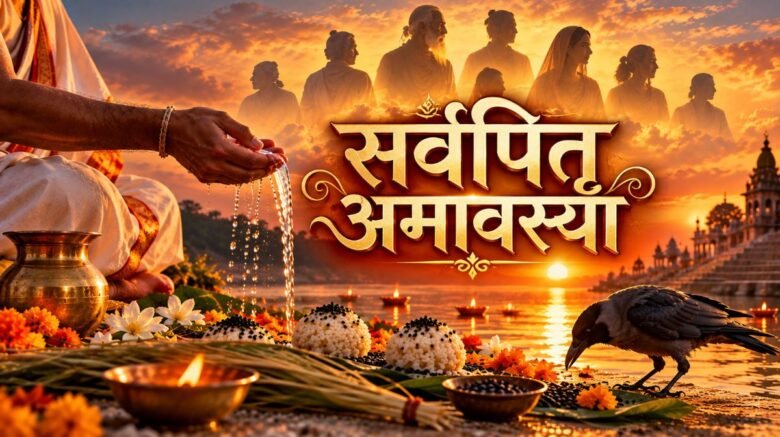
After the individual Tithis of Pitru Paksha have passed, the final Amavasya brings the remembrance of ancestors into a much wider circle. This is why it is called Sarva Pitru Amavasya—the Amavasya dedicated to all ancestors.
In Sanatana tradition, this is not simply the last day of Pitru Paksha. It is especially significant for ancestors whose exact death Tithi is unknown, whose Shraddha could not be performed on the appropriate Tithi, or whose memory the family wishes to honour collectively.
Ordinarily, Shraddha during Pitru Paksha is performed according to the lunar Tithi on which an ancestor passed away. But when that Tithi is forgotten or unavailable, Amavasya provides a broader occasion for ancestral remembrance.
When Is Sarva Pitru Amavasya in 2026?
Sarva Pitru Amavasya falls on Saturday, October 10, 2026. The Amavasya Tithi begins on the night of October 9 and continues until the evening of October 10.
| Details | 2026 Information |
|---|---|
| Date | Saturday, October 10, 2026 |
| Amavasya Begins | Approximately 9:35 PM on October 9 |
| Amavasya Ends | Approximately 9:19 PM on October 10 |
| Kutup Muhurta | Approximately 11:45 AM–12:31 PM |
| Rohina Muhurta | Approximately 12:31–1:18 PM |
| Aparahna | Approximately 1:18–3:37 PM |
The Muhurta timings above are based on New Delhi. Since Shraddha Muhurta is calculated according to local Panchang conditions, the exact timings vary by city. Check your local Panchang before performing the ritual.
Why Is It Called Sarva Pitru Amavasya?
During Pitru Paksha, Shraddha is generally performed according to the lunar Tithi on which an ancestor passed away. For example, an ancestor who passed away on Dwitiya is remembered on Dwitiya Shraddha, while an ancestor associated with Navami is remembered on Navami.
However, not every family remembers the death Tithi of every ancestor. Names may survive for generations while dates disappear from family memory. Sometimes Shraddha cannot be performed on the prescribed day. Sarva Pitru Amavasya provides a traditional occasion to remember such ancestors.
The word Sarva means “all.” The day is associated with collective remembrance rather than the Shraddha of only one particular ancestor.
Whose Shraddha Is Performed on Sarva Pitru Amavasya?
Sarva Pitru Amavasya is especially significant for ancestors whose exact death Tithi is unknown or forgotten, and for those whose Shraddha could not be performed on their designated Tithi.
Amavasya Shraddha also has a particular association with ancestors who passed away on Amavasya, Purnima or Chaturdashi Tithi in several traditional observances. The final Amavasya of Pitru Paksha also provides an occasion for families to remember their ancestors collectively.
- Ancestors whose death Tithi is unknown.
- Ancestors whose death date has been forgotten.
- Ancestors whose Shraddha could not be performed on the prescribed Tithi.
- Ancestors remembered collectively by the family.
- Ancestors associated with Amavasya Shraddha according to family tradition.
What Does the Mahabharata Say About Amavasya and Shraddha?
The Anushasana Parva of the Mahabharata contains an extensive discussion between Yudhishthira and Bhishma about Shraddha and duties towards the ancestors. Bhishma explains the worship of the Pitris and discusses the suitability of different lunar days for ancestral rites.
The text gives a special place to Shraddha performed on Amavasya. The offering of sesame-infused water, known as Tilodaka, is also associated with traditional ancestral observances.
This provides an important scriptural context for the traditional connection between Amavasya, Tarpana and ancestral worship.
Why Is It Also Called Mahalaya Amavasya?
Sarva Pitru Amavasya is widely known as Mahalaya Amavasya. It marks the completion of Pitru Paksha and is associated with collective remembrance of the ancestors.
The day has a distinctive place in Bengal and eastern India, where Mahalaya is traditionally marked by early-morning Tarpana for the ancestors. It is also associated with the arrival of Devi Paksha and the approaching worship of Goddess Durga.
Thus, this Amavasya marks a meaningful transition in the Hindu calendar: the conclusion of ancestral observances followed by the festive period devoted to Devi.
Pitru Visarjani Amavasya: The Day of Farewell
Throughout Pitru Paksha, families remember their ancestors through Shraddha, Tarpana, Pinda offerings, food and charity. Sarva Pitru Amavasya brings this period to its conclusion.
For this reason, several traditions call it Pitru Visarjani Amavasya. After offering food, water, prayers and Shraddha to the ancestors, the family respectfully bids them farewell.
Pitru Paksha is a time of remembrance; Sarva Pitru Amavasya gives that remembrance the form of a final offering and farewell.
How Is Shraddha Performed on Sarva Pitru Amavasya?
The detailed procedure varies according to family tradition, region and lineage. The following is a general traditional sequence.
- Purification: Take a bath, wear clean clothes and prepare for the ancestral rite with a devotional mind.
- Sankalpa: Remember the gotra and ancestors, then make the Sankalpa for Shraddha and Tarpana.
- Tarpana: Offer water, traditionally accompanied by black sesame and Kusha grass.
- Pinda Daan: Prepare and offer Pindas according to family tradition.
- Food Offering: Prepare and offer traditional Sattvic food in the name of the ancestors.
- Brahmin Bhojana: Where prescribed by family tradition, offer food and Dakshina to Brahmins.
- Offerings to Living Beings: Families following Panchabali may offer food to the cow, crow, dog and other beings.
- Charity: Offer food, clothes, grains, Dakshina or other useful items according to one's ability.
- Prayer: Conclude by remembering the ancestors and expressing reverence and gratitude.
Why Are Water and Sesame Important in Tarpana?
Water has a central place in Pitru rites. Tarpana is the act of offering water with the intention of honouring and satisfying the ancestors. Black sesame and Kusha grass are traditionally used in many forms of Tarpana.
The Mahabharata's Anushasana Parva also refers to Tilodaka—water offered with sesame—in connection with ancestral rites. This helps explain why sesame and water remain central to traditional Pitru Tarpana.
The heart of the rite lies in Sankalpa, remembrance and Shraddha, which give the offering its devotional meaning.
What Is Offered in Pinda Daan?
Pinda Daan is one of the central forms of ancestral offering. Rice and other traditional ingredients are used to prepare Pindas. Milk, ghee, sesame and other substances may be included according to regional and family customs.
The Pinda is offered as an expression of reverence towards the ancestors. The precise ingredients and procedure vary among traditions, so a family's established Kulachara should be followed.
Why Is Food Offered to the Crow?
In Hindu tradition and popular religious practice, the crow is associated with the ancestors. This is why a portion of the Shraddha food is traditionally offered to a crow.
Many families also offer food to cows and dogs as part of their ancestral observances. These practices express the spirit of offering food with reverence beyond the household alone.
What Should Be Donated on Sarva Pitru Amavasya?
Annadana and Vastradana have an important place in many Shraddha traditions. Depending on one's ability, families may offer food, grains, clothes, Dakshina or other useful necessities.
- Food and grains
- Rice and sesame
- Clothes
- Ghee or food ingredients
- Dakshina
- Food for cows
- Food for a person in need
The spirit of donation is not display. It is an offering made in remembrance of the ancestors and as an act of service.
Can All Ancestors Be Remembered on Sarva Pitru Amavasya?
Yes. This is one of the defining features of the day. While ordinary Tithi-based Shraddha is connected with a particular death Tithi, Sarva Pitru Amavasya allows the family to perform collective remembrance and Tarpana for its ancestors.
This becomes especially meaningful for ancestors whose names may still be remembered but whose death dates are no longer known. The tradition gives these ancestors a place in remembrance too.
Can Ancestors Whose Regular Shraddha Was Already Performed Be Remembered Again?
Many families perform collective Tarpana and ancestral remembrance on Sarva Pitru Amavasya even when the annual Tithi-based Shraddha has already been completed.
The exact additional rites depend upon family tradition and Kulachara. If a family has a specific annual Shraddha procedure, that established tradition should be respected.
What Is the Best Time for Shraddha?
Parvana Shraddha is traditionally associated with the Aparahna period. Within this period, Kutup and Rohina Muhurtas are regarded as important for the ancestral rite.
| Period | Traditional Significance |
|---|---|
| Kutup Muhurta | A specially regarded period for Parvana Shraddha. |
| Rohina Muhurta | Another important period for Shraddha. |
| Aparahna | The principal daytime period associated with Pitru Shraddha. |
For 2026, the New Delhi reference timings are approximately 11:45 AM–12:31 PM for Kutup, 12:31–1:18 PM for Rohina and 1:18–3:37 PM for Aparahna. Local timings differ according to sunrise and sunset.
Sarva Pitru Amavasya and Saturday in 2026
In 2026, Sarva Pitru Amavasya falls on a Saturday, so it is also observed as Shani Amavasya.
Saturday and Amavasya have their own religious associations in Sanatana tradition. Some devotees also worship Shani Dev, offer sesame or oil, or observe other traditional Saturday practices. Nevertheless, the central observance of this day remains ancestral Shraddha, Tarpana and remembrance of the Pitris.
What Happens After Sarva Pitru Amavasya?
Sarva Pitru Amavasya concludes Pitru Paksha. The following day, October 11, 2026, marks the beginning of the period associated with Sharadiya Navratri.
This creates a meaningful transition in the Hindu calendar. First comes remembrance of one's ancestors and the completion of Pitru rites; then the devotee turns towards the worship of Devi and Shakti.
What Mantra Can Be Used for Ancestral Remembrance?
Detailed Pitru Tarpana uses specific mantras according to the ritual tradition, gotra and identity of the ancestors. When Shraddha is performed with a priest, the appropriate mantras are recited as part of the prescribed procedure.
For a simple act of remembrance, one may sincerely remember the ancestors, state their names and gotra if known, and offer water with devotion.
May our known and unknown ancestors be remembered with reverence. May this offering made in their remembrance be accepted, and may their blessings remain upon our lineage.
Important Things to Remember on Sarva Pitru Amavasya
- Use the local Panchang to determine the Shraddha Muhurta.
- Remember the names and gotra of the ancestors where known.
- Use water, sesame and Kusha according to the traditional procedure.
- Perform Pinda Daan according to family custom.
- Prepare Sattvic food for the Shraddha offering.
- Follow the family's tradition of Brahmin Bhojana and Dakshina.
- Offer food to the crow, cow and dog if this is part of the family tradition.
- Remember known as well as unknown ancestors.
- Keep devotion, gratitude and remembrance at the heart of the ritual.
Sarva Pitru Amavasya 2026 at a Glance
| Topic | Details |
|---|---|
| Date | Saturday, October 10, 2026 |
| Primary Name | Sarva Pitru Amavasya |
| Other Names | Mahalaya Amavasya, Pitru Amavasya, Pitru Visarjani Amavasya |
| Main Purpose | Collective Shraddha and Tarpana for ancestors |
| Especially Important For | Ancestors whose death Tithi is unknown or whose Shraddha was missed |
| Main Shraddha Period | Kutup, Rohina and Aparahna |
| Place in Pitru Paksha | Final Tithi |
| Following Major Festival Period | Sharadiya Navratri begins October 11, 2026 |
The Deeper Spiritual Meaning of Sarva Pitru Amavasya
Every Tithi of Pitru Paksha brings a particular ancestral memory into focus. Sarva Pitru Amavasya expands that remembrance to include the entire lineage.
Many ancestors disappear from family memory over generations. Their names may be forgotten, their photographs may no longer exist, and their death dates may be unknown. Yet Sanatana tradition gives even these forgotten ancestors a place in remembrance through Sarva Pitru Amavasya.
The water of Tarpana becomes an offering of remembrance. Pinda becomes an offering of reverence. Food and charity become expressions of service. Remembering one's ancestors by name becomes a way of acknowledging the lineage through which one's present life has emerged.
Sarva Pitru Amavasya reminds us that a lineage is not merely a chain of names. It is the memory of countless lives through which our present has reached us. To honour the ancestors is to bow to one's roots.



💬 Your opinion matters to us!
Did you find this article useful? Do you agree or disagree with our views? Please share your thoughts, questions, or suggestions in the comment box below. We read and look forward to every single comment!